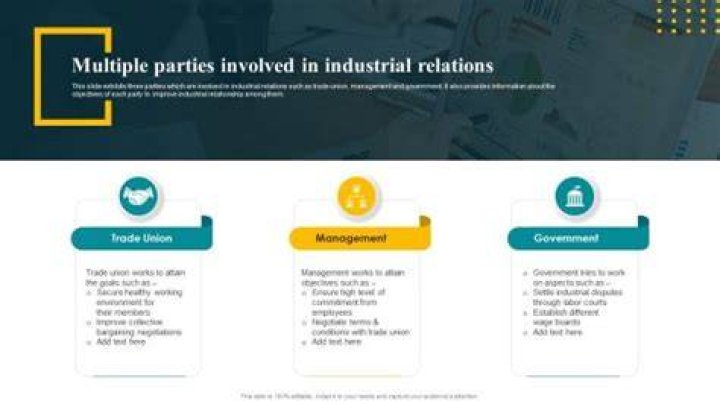
Who are the three parties involved in the negotiations?
 Chloe Ramirez
.
Also to know is, what is third party negotiation?
A judge, a lawyer, and even an agent for a movie star is a third-party negotiator. Anyone who negotiates on your behalf or listens to your pleas and then decides your fate fits into the third-party negotiator role. There are four basic third-party negotiator roles: arbitrator, conciliator, consultant, and mediator.
Also, what is a third party intervention? Definition: Third-Party Intervention Third-Party Intervention is an involvement of person/team into on-going conflict of two parties like management and union to resolve conflict.
In this way, what are the 3 phases of negotiation?
The negotiation phases differ in three main stages: preparation, development and closure.
What are the two types of negotiations?
The two distinctive negotiation types are distributive negotiations and integrative negotiations. The Negotiation Experts' sales course and purchasing negotiation training teach both methods. Both types are essential to negotiate successfully in business.
Related Question Answers
What is Batna?
BATNA is an acronym that stands for Best Alternative To a Negotiated Agreement. It is defined as the most advantageous alternative that a negotiating party can take if negotiations fail and an agreement. In other words, a party's BATNA is what a party's alternative is if negotiations are unsuccessful.How do you facilitate negotiations?
Facilitated Negotiations. Facilitated Negotiation is very similar to mediation. It is a process in which the parties in dispute identify the issues to be negotiated, and use a facilitator (mediator) to help them negotiate.What is a neutral third party?
Impartial third-party that has no financial, official, or personal interest in a controversy, dispute, or issue in which it is requested to mediate. If it has (or develops during proceedings) any such interest, it is duty bound to fully disclose it to the involved parties.What are the steps in the negotiation procedure?
There are five steps to the negotiation process:- Preparation and planning.
- Definition of ground rules.
- Clarification and justification.
- Bargaining and problem solving.
- Closure and implementation.
What is third party conflict resolution?
Third-party conflict resolution involves the use of a neutral third party to either help in the resolution of a dispute or to resolve the dispute. Disputes within organizations can be resolved by the use of a third party in three different ways.What is an example of negotiation?
Distributive negotiation examples include haggling prices on an open market, including the negotiation of the price of a car or a home. In a distributive negotiation, each side often adopts an extreme or fixed position, knowing it will not be accepted—and then seeks to cede as little as possible before reaching a deal.What is the role of a negotiator in conflict resolution?
During the process of negotiation it is the aim of any experienced negotiator to change that perspective into another perspective in which both parties unite in a joint effort to solve core issue itself. Lasting peace can only be achieved through negotiations.What is communication negotiation?
Negotiation is a method by which people settle differences. It is a process by which compromise or agreement is reached while avoiding argument and dispute. Negotiation skills can be of great benefit in resolving any differences that arise between you and others.What is the first step in negotiation?
The 5 steps of the negotiation process are;Preparation and Planning. Definition of Ground Rules. Clarification and Justification. Bargaining and Problem Solving.What are negotiation tactics?
Negotiation tactics are the detailed methods employed by negotiators to gain an advantage. Often, negotiators use negotiation tactics to fulfill their own goals and objectives. This is often to the detriment of others, making most tactics in use today “win-lose” by nature.Why do we negotiate?
The majority of us negotiate because we want to do a deal that is beneficial to all the parties involved. Negotiation is about compromise not setting up barriers that need defending, if you do not want to compromise then don't bother negotiating, tell the other party you have no interest in doing business with them.What are the basic principles of negotiation?
7 principles for effective negotiations- Know what are you trying to accomplish.
- Develop a game plan before negotiations start.
- Study and understand your counterpart.
- Work towards a win-win.
- Avoid negotiating with yourself.
- React strongly to an untrustworthy party at the negotiating table.
- Remember that it takes two parties to negotiate or renegotiate a deal.
How do you say salary is too low?
It's important to get back to the hiring manager quickly, but don't begin your salary negotiation quite yet. Deciding how to respond to a low salary offer takes time, planning, and a little bit of research if you want to be successful. Simply say thank you for the offer, but that you need some time to think about it.What type of skill is negotiation?
Negotiation skills are qualities that allow two or more parties to reach a compromise. These are often soft skills and include abilities such as communication, persuasion, planning, strategizing and cooperating.How do I become a successful negotiator?
If so, here are some tips on becoming a more effective negotiator:- Prepare. Negotiating takes tenacity and preparation.
- Everything is negotiable. Be flexible.
- Ask for what you want. This is not a time to be shy.
- Listen more than you talk. Ask questions and wait for the answers.
- Read the paperwork if need be.
What are the characteristics of negotiation?
There are definitely others that are valuable, but without these 10 essential characteristics, the negotiation game will be much more difficult to master.- Leave little to chance.
- Be patient, persistent and creative.
- Listen, listen and then listen some more.
- Show empathy.
- Be sensitive to nonverbal cues.